
POSCO Future M Posts Q3 Earnings Surprise as LFP Shift Gains Pace… “Clearly Getting Better”
Daishin Securities cuts target price 13% to 200,000 won but keeps ‘Buy’ rating… 18.4% upside from current price
POSCO Future M (003670) reported third-quarter earnings that beat market expectations. Analysts said a recovery in cathode sales volumes and volume compensation received from customers drove the results. They also expect earnings to recover in earnest from 2027, once the company’s LFP (lithium iron phosphate) cathode conversion line starts running in the fourth quarter of this year.
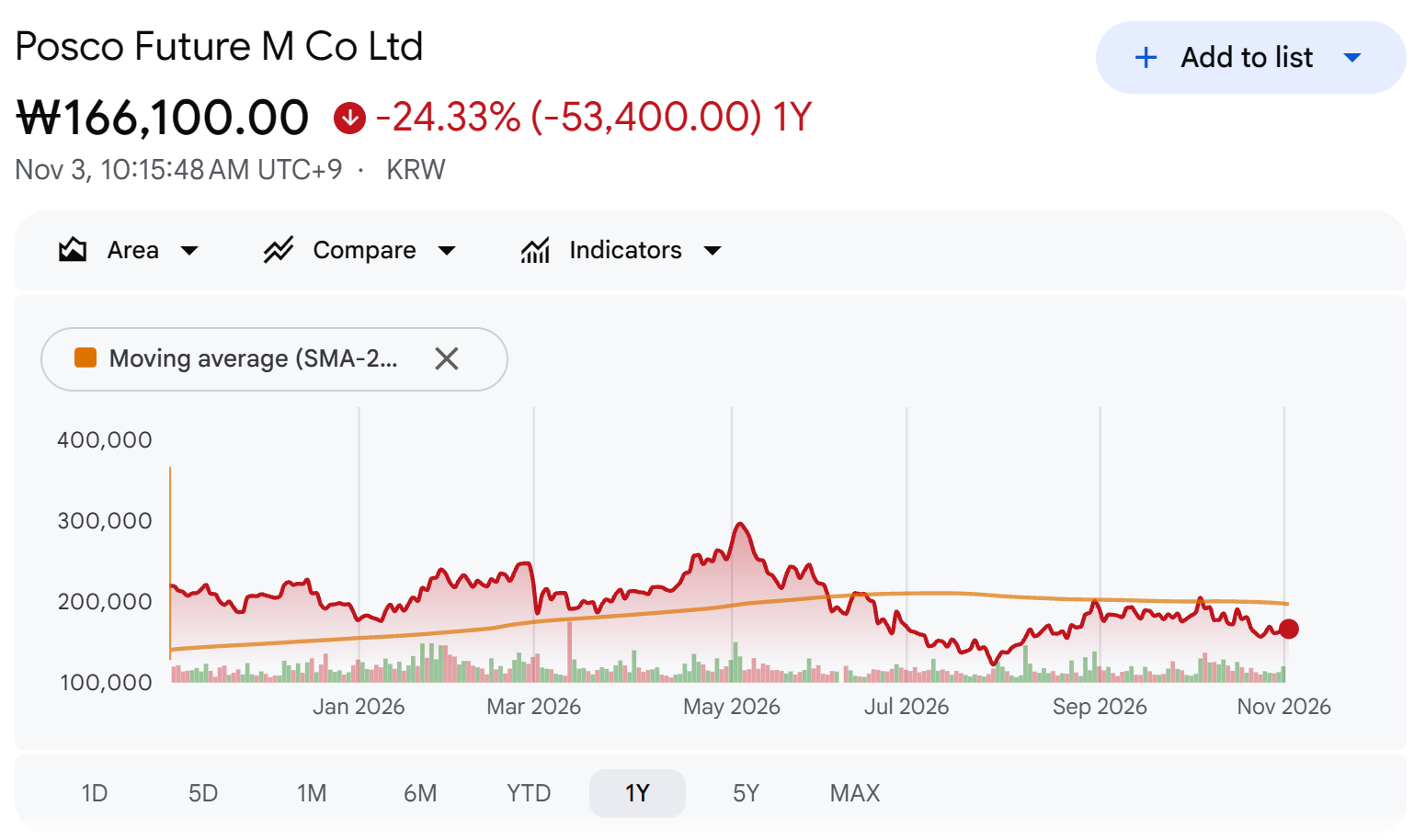
POSCO Future M share price trend
In a report titled “Clearly Getting Better,” Daishin Securities analyst Kim Gwi-yeon kept a ‘Buy’ rating on POSCO Future M.
How much did POSCO Future M’s Q3 results beat expectations?
■ Operating profit of KRW 82.1 billion, more than four times the market forecast
POSCO Future M’s consolidated Q3 revenue was KRW 834.8 billion, down 4.6% from a year earlier. Operating profit, however, rose 23.2% year-on-year and 207.8% quarter-on-quarter to KRW 82.1 billion, an operating margin of 9.8%. Net profit was KRW 42.0 billion, roughly flat from a year earlier (+0.4%) and up 83.4% from the previous quarter.
The market had expected revenue of KRW 772.0 billion, operating profit of KRW 19.0 billion and net profit of KRW 8.0 billion. Actual revenue came in about 8% above that forecast, operating profit at 4.3 times the consensus and net profit at about five times. “The earnings surprise came from a recovery in cathode volumes and compensation received from customers for volume shortfalls,” Kim said.
| Item | 3Q25 | 2Q26 | 3Q26 (prelim.) | YoY | QoQ | Consensus |
|---|---|---|---|---|---|---|
| Revenue | KRW 875.0bn | KRW 679.0bn | KRW 835.0bn | -4.6% | +22.9% | KRW 772.0bn |
| Operating profit | KRW 67.0bn | KRW 27.0bn | KRW 82.0bn | +23.2% | +207.8% | KRW 19.0bn |
| Net profit | KRW 42.0bn | KRW 23.0bn | KRW 42.0bn | +0.4% | +83.4% | KRW 8.0bn |
How did POSCO Future M’s cathode, anode and basic materials businesses perform?
■ Energy materials: Cathode sales recover, anode losses widen
Revenue in the energy materials division rose 40% from the previous quarter to KRW 459.6 billion. Before consolidation adjustments, cathode revenue was KRW 492.6 billion, up 25% quarter-on-quarter, and anode revenue was KRW 27.3 billion, down 3%. The division posted operating profit of KRW 51.8 billion, a 11% margin.
Kim pointed to three reasons for the revenue increase: higher sales of the high-nickel N87 product, resumed supply to Ford and Ultium Cells (the GM-LG Energy Solution joint venture), and volumes deferred from the second quarter that were booked in the third. Together, he said, these drove this quarter’s revenue growth.
Selling prices also rose. Higher lithium prices in the first half were passed through to product prices, and with an improved product mix, dollar-based average selling prices rose by double digits quarter-on-quarter. In anodes, by contrast, losses widened despite higher sales volumes, as lower prices, a weaker exchange rate and inventory valuation losses on synthetic graphite piled up.
■ Basic materials: Higher oil prices lift profit
The basic materials division posted revenue of KRW 375.1 billion (+7% QoQ) and operating profit of KRW 30.3 billion (+26% QoQ), an 8% margin. The improvement came as higher oil prices from the first quarter fed through with a lag, widening the spread between product prices and costs.
| Division | 3Q26 revenue | QoQ | Operating profit | Operating margin |
|---|---|---|---|---|
| Energy materials | KRW 459.6bn | +40% | KRW 51.8bn | 11% |
| └ Cathode (before consol. adj.) | KRW 492.6bn | +25% | - | - |
| └ Anode (before consol. adj.) | KRW 27.3bn | -3% | Wider loss | - |
| Basic materials | KRW 375.1bn | +7% | KRW 30.3bn (+26%) | 8% |
Why is profit expected to fall in Q4?
■ Volumes up 25%, but a high base from one-off compensation and weaker lithium prices weigh on profit
Kim estimated fourth-quarter revenue at KRW 920 billion, up 64.9% year-on-year and 10.2% quarter-on-quarter. Operating profit, however, is expected to fall 93.2% from the third quarter to KRW 6 billion, and net profit 88.2% to KRW 5 billion. Compared with a year earlier, both operating and net profit would swing back to a profit.
Three drivers of volume growth were cited: ▲initial shipments of LFP cathodes ▲deferred volumes for China ▲recovering sales to existing customers. On this basis, Q4 cathode volumes are expected to rise 25% from the previous quarter.
Profitability is still set to fall because weaker lithium prices will push selling prices down, and the one-off compensation that boosted Q3 results will not recur in Q4. Kim said that even if Q4 profitability dips temporarily, “earnings power will improve once LFP mass production is followed by full-scale deliveries starting in 2027.”
What does the LFP cathode shift mean for POSCO Future M?
■ Pohang Plant 2: 20,000 tonnes this year → 107,000 tonnes by 1H next year
LFP cathodes are the core of the report. POSCO Future M will start operating an LFP conversion line (annual capacity of 20,000 tonnes) at its Pohang Plant 2 in the fourth quarter. It plans to secure total capacity of 107,000 tonnes by the first half of 2027.
LFP is a cathode material that uses iron and phosphate instead of nickel and cobalt. It has lower energy density than high-nickel (NCM) chemistries but is cheaper and safer, and demand is growing, led by energy storage systems (ESS) and mass-market electric vehicles. POSCO Future M’s strategy is to convert part of its existing high-nickel-focused lines to LFP to respond to this shift in demand.
“As volumes ship from the conversion line capacity, we expect the cathode profit mix to improve,” Kim said. “With the industry passing its trough, the recovery in earnings power centered on LFP cathodes is positive.”
■ Anodes and basic materials also on an improving trend
Daishin expects anodes to improve, citing ▲higher Q4 sales to overseas customers ▲recovering volumes to domestic cell makers ▲expanded synthetic graphite supply. It also expects the basic materials division to keep benefiting from favorable spreads as oil prices stay high for longer.
Why cut the target price but keep a ‘Buy’ rating?
■ Earnings estimates lowered on falling lithium prices, but valuation discount removed
Daishin derived its 200,000-won target price by applying a 40x target multiple to estimated 2028 EBITDA of KRW 435.5 billion, implying an enterprise value of about KRW 18 trillion.
The 13% cut reflects lower lithium prices in its earnings estimates. With the LFP conversion line now confirmed to start operating, however, the firm removed the discount it had applied to the target multiple. “Visibility is high on volume improvement and a recovery in earnings power from LFP cathode deliveries in 2027,” Kim said, explaining the basis for the call.
| Annual results | 2024A | 2025A | 2026F | 2027F | 2028F |
|---|---|---|---|---|---|
| Revenue | KRW 3.700tn | KRW 2.939tn | KRW 3.191tn | KRW 3.799tn | KRW 3.609tn |
| Operating profit | KRW 1.0bn | KRW 33.0bn | KRW 132.0bn | KRW 130.0bn | KRW 166.0bn |
| Net profit (controlling) | -KRW 212.0bn | KRW 32.0bn | KRW 73.0bn | KRW 63.0bn | KRW 81.0bn |
| EPS (won) | -2,655 | 386 | 823 | 709 | 907 |
| PER (x) | NA | 485.0 | 232.4 | 270.0 | 211.0 |
| PBR (x) | 3.7 | 3.8 | 3.6 | 3.6 | 3.6 |
| ROE (%) | -8.0 | 0.9 | 1.8 | 1.5 | 1.9 |
On an annual basis, operating profit this year is forecast at KRW 132.0 billion, about four times last year’s KRW 33.0 billion. Revenue in 2027 is projected to grow 19% to KRW 3.799 trillion, while operating profit stays roughly flat at KRW 130.0 billion. The step up to KRW 166.0 billion in operating profit is expected in 2028.
Where does the share price stand now?
■ 43% below its 52-week high… rebounding over the past three months
As of November 2, POSCO Future M had a market capitalization of KRW 15.023 trillion, 0.23% of the KOSPI. Its 52-week high is 296,000 won and its low 122,100 won, leaving the current price about 43% below the high. Performance varies by period. The stock’s absolute return over the past month was -9.6%, but it outperformed the KOSPI by 8.0 percentage points. Over three months, it returned 22.7% in absolute terms and beat the market by 38.1 percentage points. Six-month (-33.0%) and 12-month (-22.0%) returns remain negative, however, and its 12-month relative return of -45.3% shows it lagged far behind a strong KOSPI (5,859.08).
| Share price return | 1M | 3M | 6M | 12M |
|---|---|---|---|---|
| Absolute | -9.6% | +22.7% | -33.0% | -22.0% |
| Relative (vs. KOSPI) | +8.0% | +38.1% | -24.5% | -45.3% |
The largest shareholder is POSCO Holdings and four related parties (60.55%), and the National Pension Service holds 5.04%. Foreign ownership is 8.93%, and the 120-day average trading value is KRW 62.5 billion. Dividend per share (DPS) is 250 won for both 2025 and 2026 (forecast).
What should investors watch going forward?
■ Lithium prices and the pace of LFP deliveries to customers are key
The outlook assumes stable lithium prices and LFP cathode shipments going to plan. If lithium prices fall further, pressure on selling prices will grow, and if shipments from the conversion line are delayed, the 2027 earnings recovery could also be pushed back. With an estimated 2026 PER of 232x, investors should also consider that much of the company’s medium- to long-term growth is already priced in. Operating profit is also expected to fall sharply in Q4 as the one-off compensation drops out, so short-term earnings volatility should be factored in as well.

